

ArtLab Covers
During a remote internship with ArtLab-Studio (June–August 2025), I collaborated with a team of artists and scientists to create editorial illustrations for upcoming articles from Cell Press. The program included weekly meetings to discuss projects, techniques, and progress. I produced visual concepts for complex scientific topics, translating cutting-edge research into accessible and engaging cover illustrations. Four of my designs were accepted as official journal covers, highlighting work on topics including cancer immunology, neuroscience, and pollinator health. My illustrations combined metaphorical and literal elements to capture the essence of the science while maintaining visual appeal and clarity.
Trends in Biotechnology
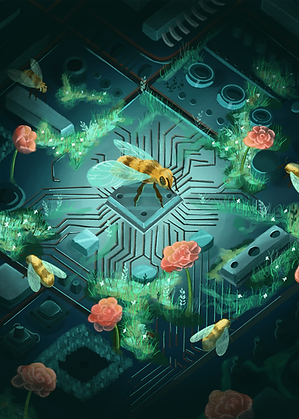
BioTech Bees
This article explores how biotechnology can help protect declining bee populations by addressing the complex challenges they face. The illustration shows a queen bee at the center of a circuit board, symbolizing AI- and omics-driven innovation, while worker bees, flowers, and grass emerging from the circuitry represent how technology and nature can work together to strengthen pollination, biodiversity, and the future of beekeeping.
Cell Reports- Medicine
Targeted Growth
This special issue focuses on new approaches to targeting the tumor immune microenvironment, with reviews on CAR-T cells, NK cells, dendritic cells, cancer-associated fibroblasts, and macrophages, as well as an expert Q&A.
The cover illustration uses a gardening metaphor, showing a gardener removing cancerous “weeds” while healthy cells bloom around them.


Trends in Cognitive Science
Paradox of Virality
My illustration reflects the paradox of virality from the article, How viral content can dominate attention while people remain emotionally disconnected. The tornado of social media icons shows the overwhelming spread of information, while most people go about their day, unfazed, highlighting the gap between visibility and genuine engagement.
Trends in Endocrinology
Choosing the Right Fuel
Neurons require constant energy but prioritize mitochondrial health over rapid fuel use. By limiting glycolysis, neurons preserve NAD⁺ to support mitophagy, allowing healthier mitochondria to efficiently use alternative fuels like lactate and ketone bodies. The illustration reflects this balance through two gas pumps: one run-down and neglected, symbolizing inefficient or less favored energy pathways, and the other vibrant and active, representing the optimized energy system neurons rely on to sustain long-term brain function.


